10 Critical Signs You Need New Siding Raleigh NC: A Master Craftsman’s Guide

What if the small hairline crack on your home's exterior isn't just a cosmetic flaw, but a silent invitation for moisture to compromise your entire structural foundation? It's natural to feel a sense of unease when you spot warping or subtle discoloration, as recognizing the signs you need new siding Raleigh NC is the first step toward preserving your home's legacy. You've invested deeply in your property, and the uncertainty of whether you're facing a simple repair or a full replacement can be unsettling. You deserve a partner who values precision and understands the weight of your investment.
This guide provides the professional clarity you need to identify the indicators of failure and safeguard your home's long-term health. We'll move beyond surface-level aesthetics to explore the underlying markers of material decay that often go unnoticed by the untrained eye. By adopting this master craftsman's framework for evaluating home health, you'll gain the assurance that your residence remains a sanctuary of durability and refined taste. We'll examine ten essential indicators of deterioration, ranging from hidden water intrusion to diminished energy efficiency, ensuring you have the knowledge to protect your home's structural integrity and aesthetic value.
Table of Contents
The Essential Function of Residential Siding Systems
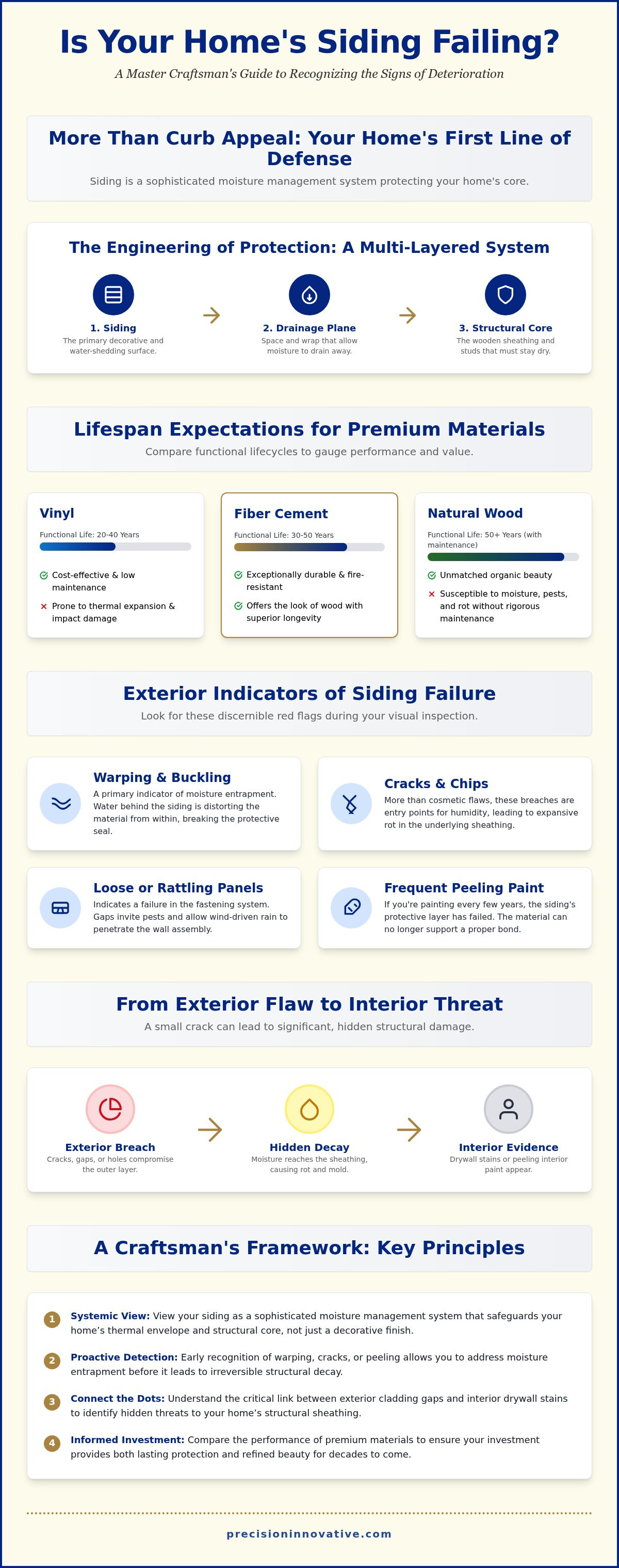
Your home's exterior serves as a sophisticated moisture management barrier, acting as the primary shield against the elements. While many view Siding (construction) as a purely decorative element, it's actually the most critical component of your property's thermal envelope. A meticulous installation ensures that the wall assembly remains dry, preventing the structural decay that occurs when moisture reaches the wooden studs and sheathing. When you begin noticing the signs you need new siding Raleigh NC, you aren't just looking at a cosmetic update; you're witnessing a breach in your home's fundamental protection system.
The psychological impact of a pristine exterior shouldn't be underestimated. Curb appeal is a direct reflection of a homeowner's commitment to excellence, influencing both property value and the sense of pride you feel every time you pull into the driveway. A high-end siding system provides a seamless transition between exterior protection and interior comfort, ensuring your investment remains secure for decades. Understanding the engineering behind these materials is the first step in a master craftsman's approach to home health.
Beyond Aesthetics: The Engineering of Protection
Modern siding systems are designed to redirect bulk water away from your home's foundation with surgical precision. In a high-end installation, the siding works in concert with a drainage plane and high-performance house wrap to create a redundant defense against humidity. This system allows the wall assembly to breathe while ensuring liquid water cannot penetrate the interior layers. Flashing is the critical metal barrier that prevents water intrusion at joints and openings. Without these precisely integrated components, even the most expensive cladding will eventually fail to protect the underlying structure from rot and mold.
Lifespan Expectations for Premium Materials
Every material possesses a unique lifecycle, and recognizing the signs you need new siding Raleigh NC requires an understanding of these natural timelines. Premium vinyl typically offers a functional life of 20 to 40 years, while fiber cement is renowned for its 30 to 50-year durability. Natural wood can last upwards of 50 years, though it demands a rigorous maintenance schedule to prevent premature fatigue. Environmental stressors, such as extreme temperature fluctuations and intense UV exposure, can accelerate material exhaustion. It's vital to distinguish between a material's "aesthetic life," where it simply loses its luster, and its "functional life," where it no longer provides a reliable moisture barrier.
Vinyl: Cost-effective and low maintenance, but prone to thermal expansion and impact damage.
Fiber Cement: Exceptionally durable and fire-resistant, offering the look of wood with superior longevity.
Natural Wood: Provides unmatched organic beauty but remains susceptible to moisture absorption and pest activity.
Discernible Exterior Indicators of Siding Failure
Identifying the signs you need new siding Raleigh NC begins with a meticulous visual audit of your home's facade. Surface-level imperfections often mask deeper systemic issues that threaten the structural core. Warping and buckling are primary indicators of moisture entrapment, signaling that water has bypassed the external cladding and is now distorting the material from within. When panels lose their original profile, the protective seal is broken, allowing the elements to accelerate decay.
Cracks and chips represent more than just minor impact damage from debris or weather events. These breaches serve as entry points for humidity, which can lead to expansive rot in the underlying sheathing. If you find yourself scheduling exterior painting every few years, it's likely a sign that the material's protective layer has reached its limit. A healthy siding system should retain its finish for its intended lifespan; frequent peeling suggests the substrate can no longer support a bond.
Physical Deformation and Surface Breach
Loose or rattling panels are often dismissed as a mere noise nuisance, yet they indicate a failure in the fastening system or structural movement. These gaps invite pests, such as wood-boring insects or woodpeckers, to create small holes that further compromise the wall assembly. The chalking effect is the white, powdery residue that forms when a material’s binder degrades under UV exposure. This chemical breakdown means the siding is becoming brittle and porous, losing its ability to repel water effectively.
Biological Growth and Moisture Traps
Discerning the difference between surface dirt and deep-seated biological growth is essential for home health. While dirt can be washed away, persistent mold or mildew often points to a moisture trap where the siding fails to dry properly. In natural or engineered wood products, soft spots or crumbling edges are definitive warning signs of rot. Dense landscaping can exacerbate these issues by creating stagnant micro-climates that prevent airflow, effectively trapping humidity against your home's skin. If you suspect these issues are present, a professional assessment of your exterior cladding can provide the clarity needed to protect your investment.
Assessing Sub-Surface Damage and Structural Risks
True home protection extends far beneath the visible cladding, reaching into the very bones of the structure. When external barriers fail, the path of least resistance for moisture is often inward, leading to compromised wall cavities and structural instability. Understanding the signs you need new siding Raleigh NC involves a deep awareness of how exterior gaps correlate with interior decay. Delaying a necessary replacement doesn't just impact aesthetics; it creates a cumulative financial burden. As water damage spreads from the siding to the sheathing, insulation, and eventually the interior finishes, the scope of the project expands exponentially. A master craftsman recognizes that the cost of inaction is far greater than the investment in a timely, professional replacement.
Compromised siding also places an immense strain on your home's mechanical systems. When the exterior shell is breached, your home's thermal envelope is essentially open to the elements. This leads to increased energy costs as your HVAC system struggles to compensate for the loss of conditioned air. Protecting your investment requires a methodical look at how these exterior failures manifest inside your living spaces.
The Interior Connection: Warning Signs Inside the Home
Peeling paint or sagging wallpaper on an exterior-facing wall is rarely a simple cosmetic issue. It's often a clear indicator that water vapor or liquid moisture has successfully bypassed the siding and saturated the drywall from the back. Musty odors near these walls provide further evidence of active biological growth hidden from view. If you notice a sudden spike in heating or cooling bills, it likely points to siding gaps that allow air infiltration. These gaps compromise your home's efficiency, forcing your HVAC unit to work overtime to maintain a steady, comfortable temperature during humid summers or damp winter months.
Structural Integrity and the Sheathing Layer
The sheathing layer, typically comprised of plywood or OSB, serves as the structural skin of your home. When moisture penetrates this layer through failing siding, it triggers a process of delamination and rot that creates "soft spots" in the wall assembly. These areas lose their ability to hold fasteners and provide structural rigidity, which can lead to significant sagging or leaning over time. Mold colonies often form within these dark, damp wall cavities long before they become visible on the interior drywall. Just as you would monitor your roof for leaks using a checklist for roofing health, you must treat your siding as an equally vital component of your home's weather-tight seal. Ensuring the sheathing remains dry is the only way to prevent costly structural repairs that extend into the home's framing.
A Methodical Approach to Home Siding Inspection
Conducting a self-assessment of your home’s exterior is an exercise in precision and patience. Rather than a casual glance, a master craftsman’s approach requires a 360-degree audit to identify the subtle signs you need new siding Raleigh NC before they evolve into structural crises. To begin, equip yourself with a high-powered flashlight, a pair of binoculars for upper-story views, and a smartphone to document any anomalies. Establishing a semi-annual inspection cadence, specifically in the spring and autumn, ensures that environmental stressors from the previous season haven't compromised your home’s integrity.
Documentation is the cornerstone of a successful professional consultation. By capturing clear photographs of suspected failures, you provide a historical record that allows an expert to determine the rate of deterioration. This proactive stance puts you in control of your home’s health, transforming a potential emergency into a planned, stress-free improvement project. If your findings reveal systemic issues, it’s time to schedule a comprehensive siding assessment with a dedicated partner who values your investment as much as you do.
The Exterior Perimeter Walkthrough
A systematic walkthrough ensures no detail is overlooked. Follow these steps to evaluate your home’s exterior health:
Step 1: Visual Scan for Shadow Lines. Observe your siding at different times of the day, particularly during the "golden hour" when low-angle sunlight highlights warping or buckling. Unusual shadow lines often reveal ripples or "oil canning" that are invisible under direct midday sun.
Step 2: The Physical Response Test. Check the material’s tactile integrity by applying gentle pressure to various panels. High-end siding should feel firm and secure; excessive flex or "soft spots" indicate that the underlying fasteners or sheathing have been compromised by moisture.
Step 3: Joint and Seam Analysis. Focus your attention on the transition points where siding meets window frames, door casings, and corner boards. These seams are the most vulnerable areas for water intrusion if the original caulking has failed or the flashing is misaligned.
The Professional Touch: Deep-Dive Verification
While a visual audit is essential, some failures occur deep within the wall assembly. Professional-grade moisture meters can detect humidity levels behind the cladding that are otherwise undetectable to the naked eye. You should also venture into the attic to inspect for light leaks or damp rafters near the eaves, as exterior breaches often manifest as interior stains in these secondary spaces. The "pick test" is a method where a screwdriver is used to gently probe for hidden wood rot. If the tool sinks easily into the material rather than meeting resistance, the structural fibers have failed. This level of scrutiny ensures that your home remains a sanctuary of durability and refined taste for decades to come.
Selecting Premium Materials for Lasting Protection
Once you've identified the signs you need new siding Raleigh NC, the transition from detection to selection becomes the most critical phase of your home's transformation. Selecting the right material is the foundation of a master craftsman installation; it's the difference between a temporary fix and a generational investment. While premium vinyl offers a practical, low-maintenance solution with an impressive 80% return on investment, fiber cement represents the pinnacle of residential protection. This choice dictates not only the aesthetic profile of your residence but also the long-term structural resilience of the entire wall assembly.
Modern siding profiles, such as board and batten or wider seven-inch planks, offer a sophisticated architectural language that elevates property value. Current design trends favor nature-inspired palettes, including sage greens and terracotta, alongside deep, authoritative accents like charcoal and forest green. These selections allow for a bespoke exterior that reflects both modern taste and timeless elegance. By focusing on materials that offer both durability and artistry, you ensure your home stands out as a landmark of quality in the community.
The Master Craftsman’s Choice: Fiber Cement
Fiber cement is frequently the preferred medium for high-end renovations due to its non-combustible nature and inherent resistance to wood-boring pests. It provides the organic warmth and texture of natural cedar without the susceptibility to moisture absorption or warping discussed in previous sections. This material's density offers superior impact resistance against storm debris, ensuring your home remains unyielding against environmental stressors. For a detailed breakdown of how these materials align with your financial goals, consult our Cost of Siding Replacement Raleigh NC: A Master Craftsman’s Investment Guide.
Investing in Your Home’s Future
A successful exterior renovation relies on meticulous planning and professional project management. A master craftsman doesn't just install panels; they orchestrate a comprehensive moisture management system that prioritizes fine details and longevity. Recognizing the signs you need new siding Raleigh NC is the catalyst for a transformation that defines your home's character for decades. This dedicated partnership ensures a stress-free experience, where every joint, flashing detail, and seal is executed with surgical precision. By choosing premium materials and expert execution, you secure your home’s structural integrity while dramatically enhancing its visual legacy.
Securing Your Home’s Legacy with Professional Precision
Protecting your residence requires more than a simple visual check; it demands a comprehensive understanding of how your home’s exterior interacts with its structural core. You've learned that identifying the signs you need new siding Raleigh NC is the first step in preventing costly moisture damage and preserving your property’s thermal envelope. Whether you've noticed subtle warping or internal drywall staining, these indicators serve as a vital call to action for every discerning homeowner. Your home is a significant investment that deserves a proactive approach to maintenance and protection.
Precision Innovative Construction LLC brings over 25 years of master craftsman experience to every project, specializing in high-end residential renovations that prioritize both structural integrity and aesthetic excellence. We believe in meticulous attention to every detail, from the underlying drainage plane to the final architectural finish. Schedule your professional exterior consultation today to ensure your home remains a sanctuary of durability and refined taste. Your investment deserves the steady, experienced hand of a partner dedicated to your home’s long-term health and beauty.
Frequently Asked Questions
Can I just paint my old siding instead of replacing it?
Painting provides a temporary aesthetic refresh, but it cannot restore the structural integrity of a failing substrate. If the material exhibits signs you need new siding Raleigh NC such as rot or deep-seated moisture absorption, paint merely masks the underlying decay. A master craftsman prioritizes the health of the wall assembly, as applying a new coat over compromised panels often leads to rapid peeling and further material exhaustion.
How long does fiber cement siding typically last compared to vinyl?
Fiber cement siding typically offers a functional lifespan of 30 to 50 years, while premium vinyl generally lasts between 20 and 40 years. The superior durability of fiber cement stems from its non-combustible composition and resistance to UV degradation. While vinyl is cost-effective and low maintenance, fiber cement provides a more robust barrier against environmental stressors and maintains its aesthetic profile for a significantly longer duration under varied climate conditions.
Is warped siding always a sign of water damage behind the walls?
Warping is a definitive indicator of material stress, often resulting from moisture entrapment or improper installation that restricts thermal expansion. When panels buckle, they create gaps in your home’s thermal envelope, allowing humidity to reach the structural sheathing. While heat exposure can cause surface distortion, persistent warping typically suggests that the moisture management system is compromised and requires a professional assessment to prevent internal rot.
Does new siding installation improve my home’s energy efficiency?
A new siding installation significantly enhances your home’s energy efficiency by fortifying the thermal envelope. Modern systems utilize advanced house wraps and integrated insulation layers to reduce thermal bridging and air infiltration. This meticulous approach minimizes the strain on your HVAC system, ensuring your interior remains comfortable while lowering monthly utility costs. It's a strategic investment that pays dividends in both structural protection and long-term operational savings.
Can I replace just one side of my house’s siding if only that area is damaged?
Replacing a single elevation is technically possible, but it often presents challenges regarding material matching and aesthetic continuity. Siding fades at different rates based on sun exposure, making a partial replacement conspicuous. If one side shows signs you need new siding Raleigh NC, the other elevations likely share the same age and environmental fatigue. A comprehensive replacement ensures a uniform protective barrier and maintains the cohesive architectural integrity of your residence.
What happens if I ignore small holes or cracks in my siding?
Ignoring minor breaches like small cracks or insect holes invites liquid moisture and humidity into the wall cavity. These small openings act as conduits for water, which eventually saturates the plywood sheathing and encourages mold growth. What begins as a negligible cosmetic flaw can rapidly evolve into a systemic failure requiring extensive structural repairs. Timely intervention is essential to prevent the scope of damage from expanding into the home’s framing.
How do I know if my siding issues are structural or just cosmetic?
Cosmetic issues generally involve surface-level concerns like fading, dirt accumulation, or minor staining that doesn't affect the material’s integrity. Structural issues manifest as soft spots, persistent interior moisture, or panels that feel loose and unstable when touched. If you can easily depress the siding or find evidence of rot in the underlying layers, the failure is systemic. A professional inspection utilizes moisture meters to confirm if the damage has reached the structural assembly.
What is the best time of year to schedule a siding replacement?
Spring and autumn are traditionally the most favorable seasons for siding replacement due to moderate temperatures and lower humidity. These conditions allow for optimal sealant curing and minimize the risk of material expansion or contraction during the installation process. However, a seasoned professional firm can execute a successful transformation year-round through meticulous project management and weather-contingent planning. Scheduling during the off-peak months often allows for more flexible project timelines.


Comments